Sunday, January 01, 2012

Brazil - Chapada Diamantina - Part 1

Lençóis is Portuguese for linen or sheet. The town of Lençóis, tucked up against the huge national park Chapada Diamantina, gets its name from, well, laundry. Okay, it’s a bit more romantic than that. Surrounding the city there’s a series of rocky shelves where water flows and collects in small pools. To this day, people do laundry upon the rocks, and spread colorful clothing out in the sun to dry. It’s a charming scene that adds charm to an already charming town. There is so much charm up in this place.


We got there by bus, Sean and I, about 8 hours of it. Much of the country can be seen this way. The long-distance buses are air-conditioned, with comfortable chairs that allow room for sleeping. There’s a bathroom with a window in it, where you can even watch the miles of green jungle vegetation stretch on and on, occasionally broken up by small towns and cities, all while you do your business.

It was approaching midnight when we finally rolled up into the cobblestone streets of Lençóis.  Our guide, Dida, was waiting there with a sign. He had been recommended by Sean’s art institute and turned out to be a fun, friendly fellow, fluent in French, Portuguese, Spanish, and (most importantly) quite adept in English from the time he spent as an exchange student in Montana. We had booked a Pousada in town (Pousada dos Duendes, or "the Two Gnomes") and decided to stay there despite Dida’s offer to stay at his house. It sounded quaint, Dida's house, up on a hill overlooking the city, but it wasn’t yet hooked up to the electrical grid and, call my crazy, I prefer electricity. As it would turn out, power is a fickle creature in Lençóis, and not always available following anything more intense than, say, a light rain. But our Pousada was comfortable, packed full of other friendly international tourists, and the rooms had hammocks on the balcony. I could see why the internet reviewers were so fond of it.


The next day I was awoken by so many cocks. I thought maybe since we had come in the dead of night I hadn’t noticed that Lençóis contains no actual people but is populated entirely by roosters. And each of those roosters has its own pet rooster who in turn owns several rooster farms, and all of them together are so enraged by the morning sun that they must simultaneously voice their displeasure. It’s that energizing morning punch-in-the-face that gets you ready for an exciting day. It was appropriate.

Dida collected us after breakfast and had planned a strict regimen of amazingness for the day. Chapada Diamantina (translation: Diamond Plateau) is 1,500 kilometers of beautiful landscapes. It is semi-arid, so there are many drier, deserty parts that don’t resemble much of Brazil, but there is also plenty of wetlands and jungle. Lençóis, which acts as a basecamp, subsists largely on ecotourism, and many visitors spend upwards of a month exploring the park. We had 4 days, but we made them count.

We got our feet wet, figuratively and literally, on a hike along a river that first morning. The river, surrounded by rocky canyon walls reminded me a bit of Zion National Park, if you replaced the vegetation and changed the color of the stone. I was in my element. There are few things I love more about America than its national park system. Ken Burns rightly called it “America’s best idea” and I was pleased to learn that Brazil has 67 protected parks of its own.


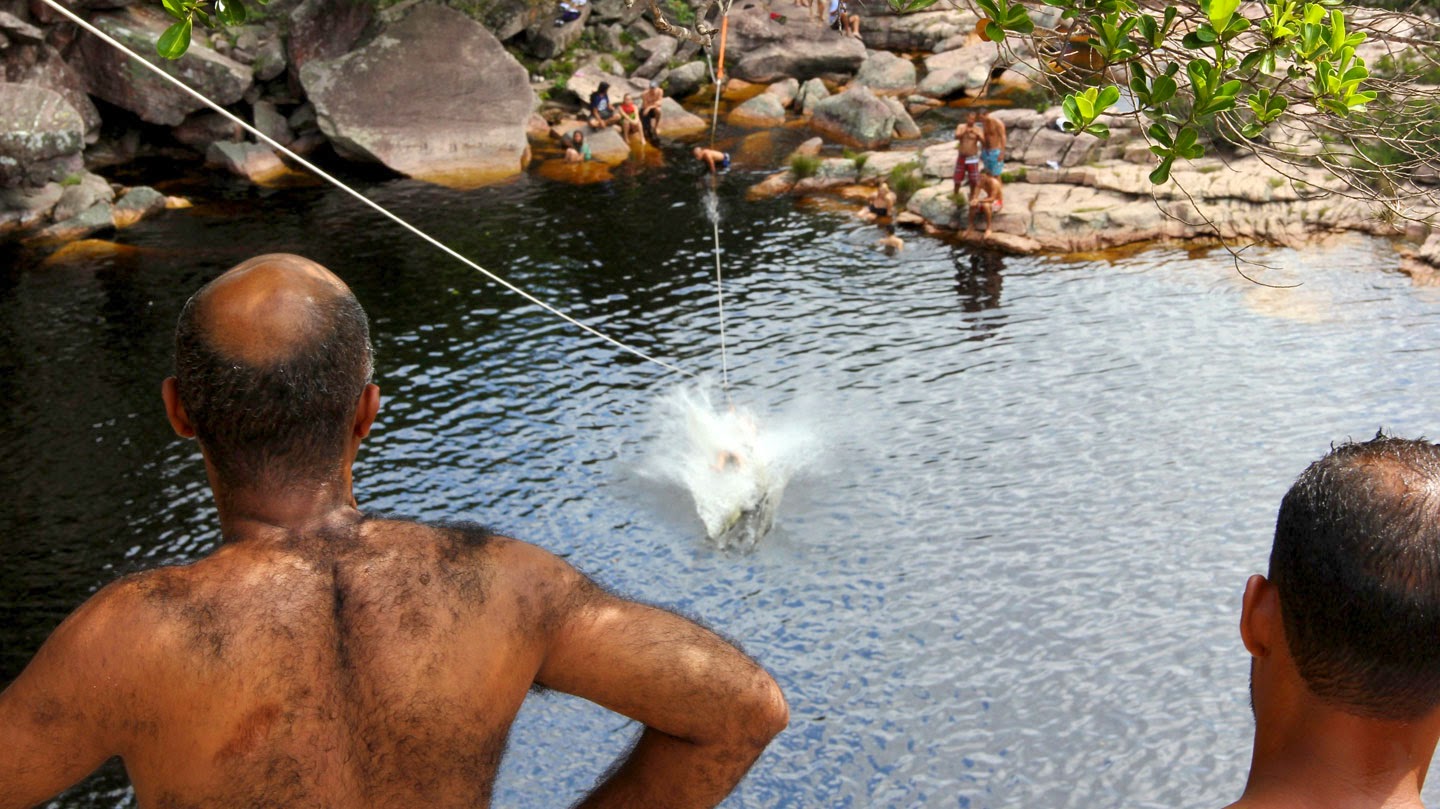
Mid-hike we came upon a rock cliff where you can take a zip line down into the water, so of course I had to do this. Fun: check. (Note: that's me splashing down in the picture below. Sorry about the guy with the back hair). 


Next up was a cave, where we put on hard hats and listened to the familiar definitions of stalactites and stalagmites and the explanations of thousand-year-old formations. The cave guides were a family that own a small restaurant and garden just outside, where passion fruit and fragrant herbs grow in abundance. Our lunch was served family-style, with a healthy variety of rice, beans, spiced cactus, fried banana, grains, and beets. Everything was delicious.


I took another zip line, later in the afternoon, down into a lake being fed by the water flowing out of another cave.  The water there is turquoise in the sunlight and clear with hundreds of tiny minnows that schooled around my legs each time I waded in. It was hot, but the lake was cool, and floating in it was a delight. We chatted with a few guys from our Pousada, two from Italy and one from Switzerland. We seemed to bump into a lot of our fellow travelers wherever we went, as everyone, regardless of their guide, seemed to end up at the same places on the circuit. Dida knew everyone, and everyone knew him, no matter where we seemed to go. Saw another cave on the way out. This place be cavey. 


Later, we drove through the park to the high, flat cliffs that give Chapada Diamantina the nickname, “Grand Canyon of Brazil.” It was a steep hike to the top, but it was quite a view. Up there, the flora was made up of spiky cactus and other succulents growing right out of the rock. Still, flowers seemed to cover everything. It’s funny how with only a short drive the landscape of the park would change dramatically. It was like visiting several parks in one.


By the time it was dark, we were back in Lençóis.  A couple narrow streets are all that make up the downtown but, due to all the tourism, there’s a large variety of restaurants.  I was surprised how good everything was. Every place we ate at was so ridiculously delicious. Lençóis is pretty much in the middle of nowhere with few permanent residents, but even in the heavily-populated, urban Salvador I never ate half so good. That first evening we tried the town’s one vegetarian restaurant. Okay, Restaurant, how did you make my soy burger taste that amazing? What kind of sorcery is this? Or maybe it was the pleasant exhaustion one feels after a long, active day that somehow enhanced the taste of everything like a magic MSG. Whatever. Food was grub.

Tuesday, December 27, 2011

Brazil - Salvador - Part 2


In Pelourinho, there’s an elevator that divides the upper and lower city. The view from up top is fantastic: the lower-city bay, turquoise and dotted with ships, edged up against the Mercado Modelo, a crazy flea market.  Melody and I met Sean and another Sacatar artist at the elevator, where they had just come in from Itaparica island. Together we visited an African and anthropology museum, which had very few descriptions in English, but a lot of great stuff to look at. We met Gary for lunch at the “Boobie Restaurant.” I don’t remember the real name, but there were paintings of bare-breasted Brazillian women everywhere for some reason.  And then onto another museum. This time in an old Catholic church which featured paintings, sculptures and other religious art. The museum had as many hanging, bloody Jesuses as the boobie restaurant had boobies. Interesting contrast.


Sean had to head back to the island, so Melody and I continued on to Pelourinho again to do some window shopping and kill some time before the big show. Every tourist center and person we met suggested we watch the “Balé Folclórico da Bahia” which features traditional African rhythms and music, capoeira, and fire dancing.  It was quite spectacular, especially the capoeira dancers whose athleticism was astounding. Before the show, I talked to a group of young Aussi/New Zealanders who were sitting one row up. One kid with shaggy, Bieber-hair and a very thick Kiwi accent asked if I was American. “I heard you talking in the lobby,” he said. “Your accent is sooo strong.”  Hah!


After the show, Melody and I had dinner back in Barra, and enjoyed a nice long chat. I really lucked out with the TravBuddy thing. Melody made a great traveling companion and I was sad to see her go the next morning. We had planned to take a bus to the airport (much cheaper!), her to catch a plane to Rio, and me to recover my long-lost luggage. But by morning it had started to rain so hard, the corridor of the Pousada flooded. We had to take a taxi for the 45 minutes instead. When I finally laid hands on my wayward bag, I was ecstatic. The rain let up enough for me to catch the bus back to Barra, and I immediately showered and changed into fresh clothes. Heaven!


Then it was off to the Mercado Modelo, the lower-city flea market, with some friends from the Salsa club: Johana, Hamurabi, Gabrielle, and Older-Man-From-Japan/Orange County. It was some kind of national holiday, so the market was packed with people. One skanky lady in particular would not stop dancing and swinging her bleached hair around. Round and around and around. She was like a machine. It was hypnotizing.

I sampled a bunch of local food and drink. My favorites: fried cheese on a stick with some kind of sweet oil, and this hot dog thing that had so many interesting toppings you could barely taste the meat. In the afternoon we caught a bus along the beautiful coastline to a neighborhood north of Barra for more deliciousness. We finished the day back in Barra, sitting at tables with a view of the sea. The night was cool and breezy, a welcome relief. More of Johana’s friends joined us and we were entertained by two drag queens with microphones. They had a whole comedy routine going on, but I didn’t understand a word of it. Judging from the reaction of the crowd it was hilarious? They did lip-sync several American power ballads pretty convincingly. There was more to that night, but this is enough for the blog. The next day I would be in a totally new place, far away from the coast.


Saturday, December 24, 2011

Brazil - Salvador - Part 1

PREFACE
The problem with blogging a long trip is always the details. There are just too many of them.  A typical non-vacation day would be easy to summarize. Wake up. Spend 11 hours or so in a car and at work. Then a few semi-eventful hours in the evening: take care of kids, or work on a personal project, prune the tomatoes, watch television, yawn, and then: finito.

Brazil was not like this. Most days in Brazil felt like a week compressed into 24 hours. Towards the end of the trip, when I was alone and parked in a hammock in a remote guesthouse in a remote part of a sleepy island, life finally slowed down. But not in the packed days in Salvador, or the long days in Chapada Diamatina, where it seemed all I did was go, go, go, and see, see, see.

The details all scuttle past each other, trying to get to the front of the line. Some are shoved aside in their frantic pursuit to be known and I don’t have the energy, nor the will to call them back. Here are some that made the cut.

SALVADOR
In terms of population, Salvador is the third largest in Brazil, behind Sao Paulo and Rio. It is also one of the most economically unbalanced, with slums and shantytowns amongst modern infrastructure and tourist areas. During my 4 days in the city I stayed in a pousada (guesthouse or small hotel) called La Villa Francaise. It’s run by two ladies from France. My reasoning was simple: my Portuguese is pretty non-existent (and almost no one speaks English in Salvador) but at La Villa Francaise I was guaranteed to be able to communicate in at least one language. It worked out. The pousada is in the touristy Barra neighborhood, 5 minutes walk from the beach. The streets (like most streets in Salvador) could still be dangerous at night, but it felt relatively safe.  


My flight had been long, and I was sick through most of it: sore throat, fever—my body’s not-so-subtle way of screwing with me. “Oh, so you want to have a great vacation?” it says. “Well guess what: BAM! awful sickness! Hah! Didn’t see that coming did you? Hahahah” What an asshole.

The thing is, I was so ticked at the prospect of spending 15 days shivering in a sick bed, that I fought back. “Oh so that’s how you want to play this?” I told my body. Well how about I just go and march right into the ocean? Huh? You wanna become a bloated corpse, huh? I WILL *&#-ING DO THIS!”

“Okay, be cool,” my body says, slowly backing away. “It was a joke, for giggles, that’s all. I’ll be good.”

And a day later I was feeling just fine.  Probably didn’t smell great, tho. The airline had lost my luggage and I had to buy a change of clothes at an overpriced mall. I wore those clothes for 3 days, in the heat and humidity. I showered a lot, but still.

INTERLUDE
I guess I should interject here and briefly explain why I was in Brazil in the first place. First off, it had felt way too long since my last international trip (China). Second, I had just completed 7 months of very taxing work days, made even lovelier with a 2-3 hour daily commute. Family life was…complicated…as it has been since I moved back to California. I needed to get away. So when my friend Sean told me he would be spending a couple months in an artist residency program in an island off the coast of Salvador and also that I should come visit, I thought: Yes, this is a thing that I should do.

And so, after buying a round-trip ticket and dealing with the long headache of my visa, here I was on a new continent, in a country I honestly didn’t know much about (subsequent internet research and reading has helped me remedy that somewhat.)  I also would be traveling mostly solo, since Sean was on an island 90 minutes off the mainland working on art, and we would only hang out for about a third of the trip. I’m generally okay with being alone. I prefer it more often than not. Solo vacations have many high points: you pick your own schedule; you do whatever you feel like doing at any particular moment. But for me, solo vacations are never sustainable over the long-run. Fine for a few days, maybe, but if not planned right, then comes the repressive feeling of isolation, of being cut-off from everyone you know and love by a distance of half the world. It can get lonely.

I planned for this. I went on TravBuddy (a site for meeting travel friends) and asked if anyone else would be in Savador when I was. And the next day I was contacted by Melody, who lives in Los Angeles and happened to be traveling in Salvador for some of the days I was. We talked by email, then by phone, and on my second day in Salvador she arrived at La Villa Francaise, staying in the next room. That was easy.


PELOURINHO
For two days, Melody and I explored the city together.  It’s a funny situation. You meet someone for the first time and then proceed to spend nearly every waking minute with that person, packing in as much as you can. It doesn’t necessarily matter if you aren’t instant bosom friends—you already share the same immediate goals: explore this foreign place. Get to know it. Getting to know each other is just bonus. We managed to fit in both.

Most of our escapades took place a short taxi ride away in Pelourinho, the historic center of the city and main tourist draw. The buildings are centuries-old colonials in bright, sunny colors, intersected by hilly, cobblestone streets and narrow alleyways. There are old, ornate cathedrals and a scattering of museums all along the main plaza. Vendors and capoeira dancers are plentiful, and so are police, who keep the area safe for tourists.


At the Terreiro de Jesus we met Gary, a Scottish sportswriter living in Dubai. He spoke English and so the three of us spent the rest of the day together. When things in Pelhourino started to close, we hopped a cab to the modern art museum. It was being renovated, but the area around it was gorgeous: a boardwalk along the shore, a small beach, a sculpture garden.


We were back in Barra by sunset, walking along the beaches of Porto de Barra, and the lighthouse of Praia de Barra. The light was perfect, and my camera kept busy. 


Later, the 3 of us hopped a cab back to Pelhourino for a street party. We arrived just after a band had stopped playing, but the narrow streets were still packed with party-goers. And then it started to rain. Hard. Ducking into a small bar, we talked to a New Yorker who recommended a salsa club somewhere nearby. The rain didn’t let up so Melody took a cab back to Barra, while Gary and I soldiered on. The rain grew heavier, but the streets were still flooded with people, some pressing themselves against the buildings where short overhangs kept back a bit of the deluge. We finally found the club, which was African-themed with a live band and a whole lot of friendly Brazilians.  It’s amazing how much conversation you can have with only a few words, a lot of hand gestures, and patience.  By 3 a.m., I was headed back to Barra in a taxi with some of our new friends: Johana (who spoke English) from Columbia, Hamurabi, a piano professor from northern Brazil, and others whose names I’ve misplaced. A good night.